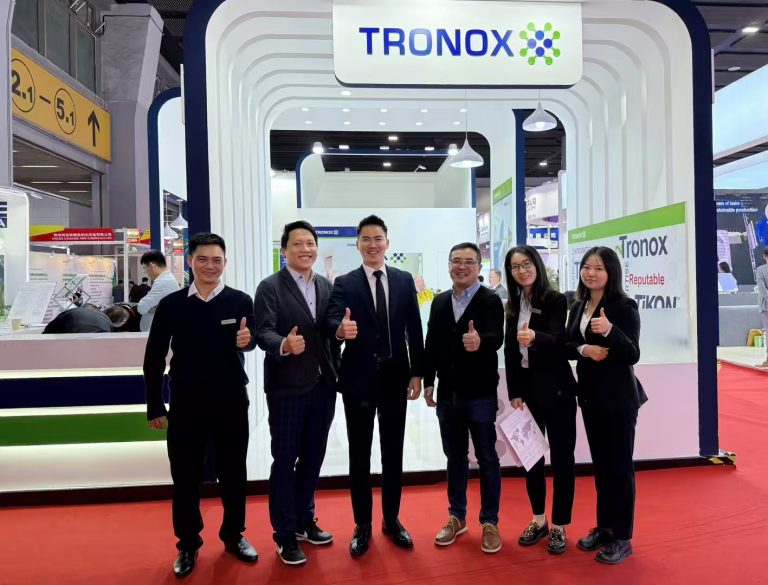

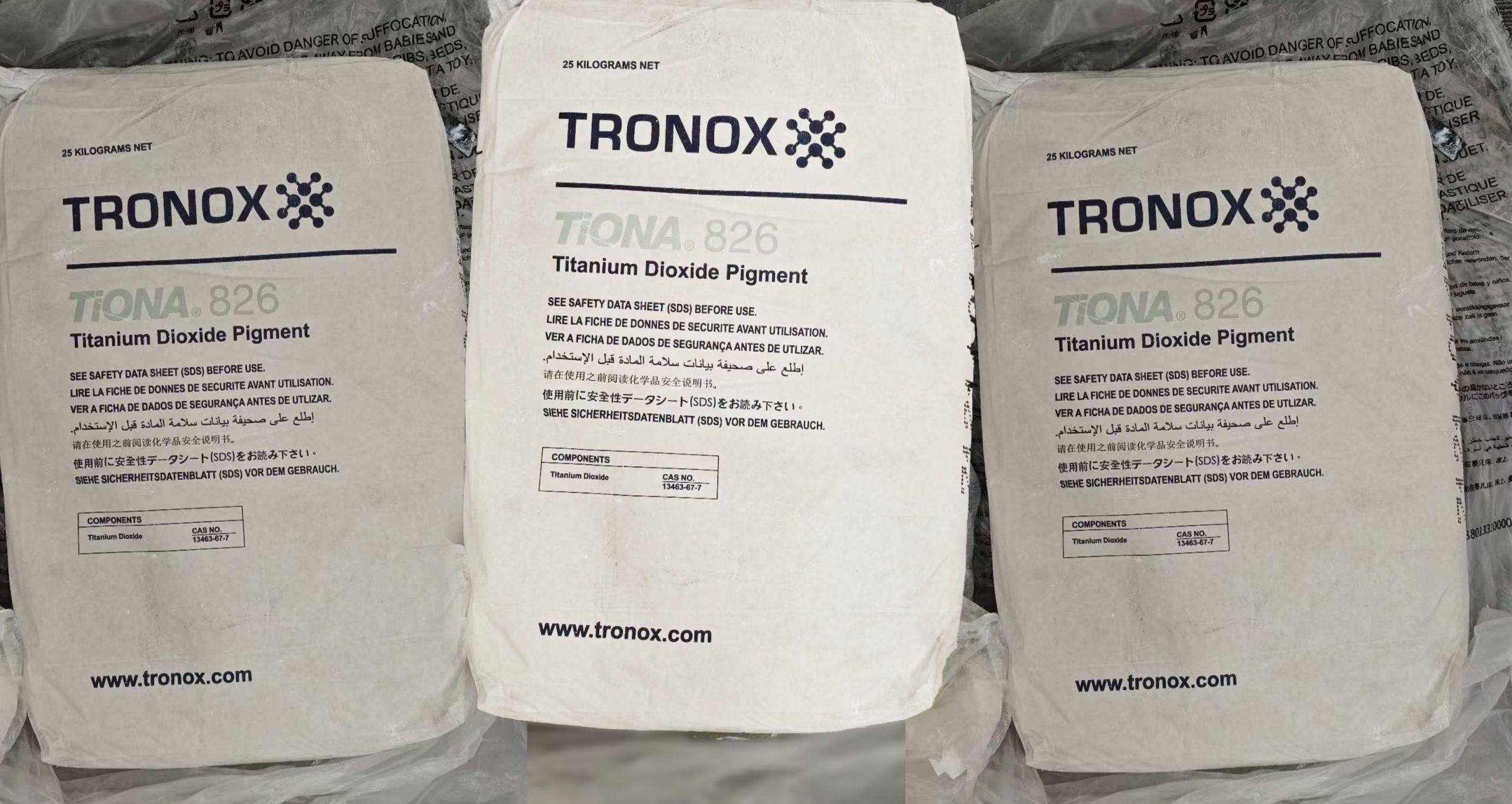
TRONOX TiONA 826 chloride process rutile titanium dioxide 25kg bag, for coatings and weatherable outdoor plastics

TiONA 826: Visual Similarity in Lab Samples Does Not Equal Direct Replacement for Production

Against the backdrop of advancing domestic titanium dioxide manufacturing, many grades are marketed as drop‑in alternatives to TiONA® 826. When formulators run lab trials, these candidates often deliver comparable whiteness, hiding power and gloss. It is tempting to conclude that switching will cut raw material costs without side effects.

Field feedback from manufacturers, however, consistently shows that passing bench testing is not the same as reliable, repeatable performance under real production conditions.

TiONA® 826 is a chloride‑process rutile titanium dioxide pigment from Tronox, with a TiO₂ content of 93%. It features an alumina‑silica‑organic composite surface treatment, engineered to balance high gloss and dispersion for coatings while delivering long‑term weather resistance for outdoor plastics. With a fixed oil absorption of 18 g/100 g and tightly controlled particle size, it serves waterborne, solvent‑borne, powder, marine protective and low‑VOC high‑solids coatings, as well as weatherable outdoor plastic components. It is a versatile chloride‑process TiO₂ built for both coating and plastic applications.
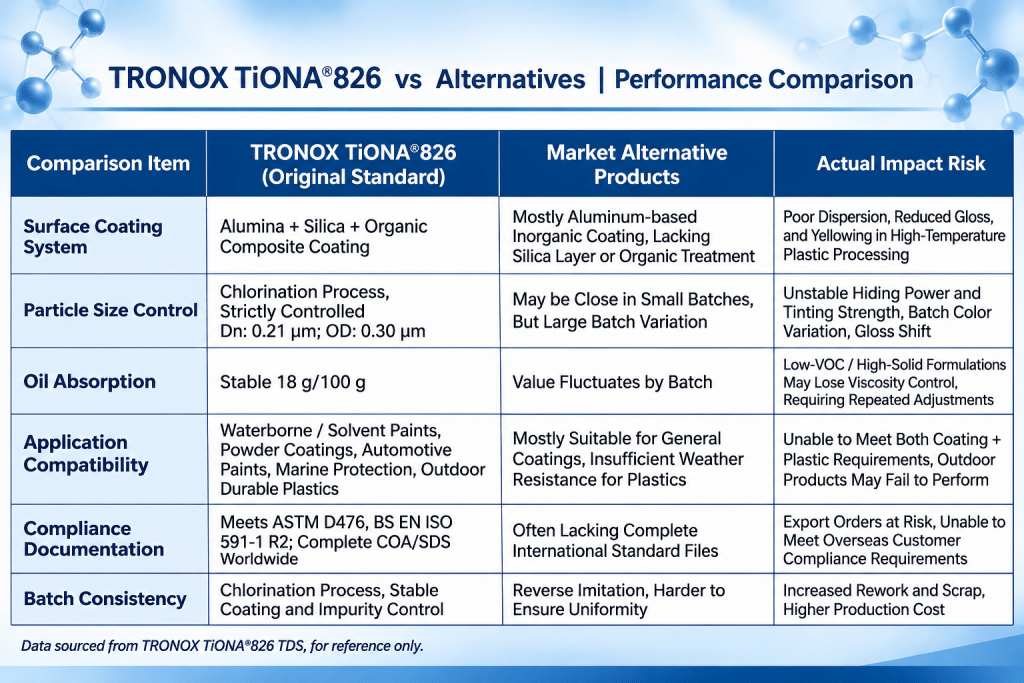
Performance comparison table: original Tronox TiONA 826 vs substitute titanium dioxide, surface coating, particle size, oil absorption, applications, compliance and batch stability
Side‑by‑side comparison of genuine TiONA® 826 and lookalike TiO₂, with production risk notes

Key Differences Between Original TiONA® 826 and Alternative Grades

The proprietary chloride process enables precise particle size control: a centrifugal mean particle size of 0.21 μm and a light‑scattering mean of 0.30 μm. This narrow particle distribution sustains consistent hiding and tinting strength. Together with stable oil absorption (18 g/100 g) and pH at 8.4, it integrates smoothly into most coating and plastic formulations.

Many competing grades can be tuned to match visual indicators, yet few replicate the full alumina‑silica‑organic encapsulation. This creates recurring production risks:
  • Incomplete or uneven surface encapsulation
    Matching visual appearance is relatively straightforward, but the composite coating must protect pigment particles for both coating gloss/dispersion and high‑temperature plastic processing. Most alternatives lack a dense silica layer or sufficient organic treatment. These flaws remain invisible in static lab samples but emerge during continuous runs: poor dispersion, gloss drop, reduced weatherability, and higher yellowing risk in extruded plastics.
  • Unstable batch‑to‑batch performance
    Chloride production demands strict control over impurities, particle size and coating chemistry. Many alternatives perform well in single lab samples but drift across batches. Consequences include fluctuating gloss and tint strength in liquid and powder coatings, and visible colour shifts in outdoor plastic parts, sometimes leading to scrapped finished goods.
  • Limited dual‑system compatibility
    One defining strength of TiONA® 826 is its ability to support both coatings and weatherable plastics. Most substitutes work acceptably for simple coating systems but degrade rapidly under extrusion heat, losing weathering and thermal stability when moved to plastic lines.
  • Risks in high‑solids, low‑VOC formulations
    The consistent oil absorption of 18 g/100 g makes TiONA® 826 suitable for modern low‑VOC high‑solids coatings. Many alternatives behave adequately in conventional solvent systems but raise viscosity and impair levelling in high‑solids formulas, forcing repeated reformulation and extra R&D expense.
  • Incomplete compliance documentation for export
    TiONA® 826 meets ASTM D476 and BS EN ISO 591‑1:2000 Type R2, supported by global regulatory filings, COA and SDS packages required by overseas buyers. Many lookalike grades cannot supply the full compliance record, halting export projects at the qualification stage.

This article does not dismiss the value of domestic titanium dioxide. For interior architectural coatings or non‑weatherable general plastics, properly selected local grades can deliver attractive cost performance. For automotive OEM and refinish coatings, marine protection, powder coatings, low‑VOC high‑solids systems, durable outdoor plastics and export orders, weather resistance, batch consistency and regulatory compliance become non‑negotiable. A matching lab sample is not the same as a dependable production raw material.

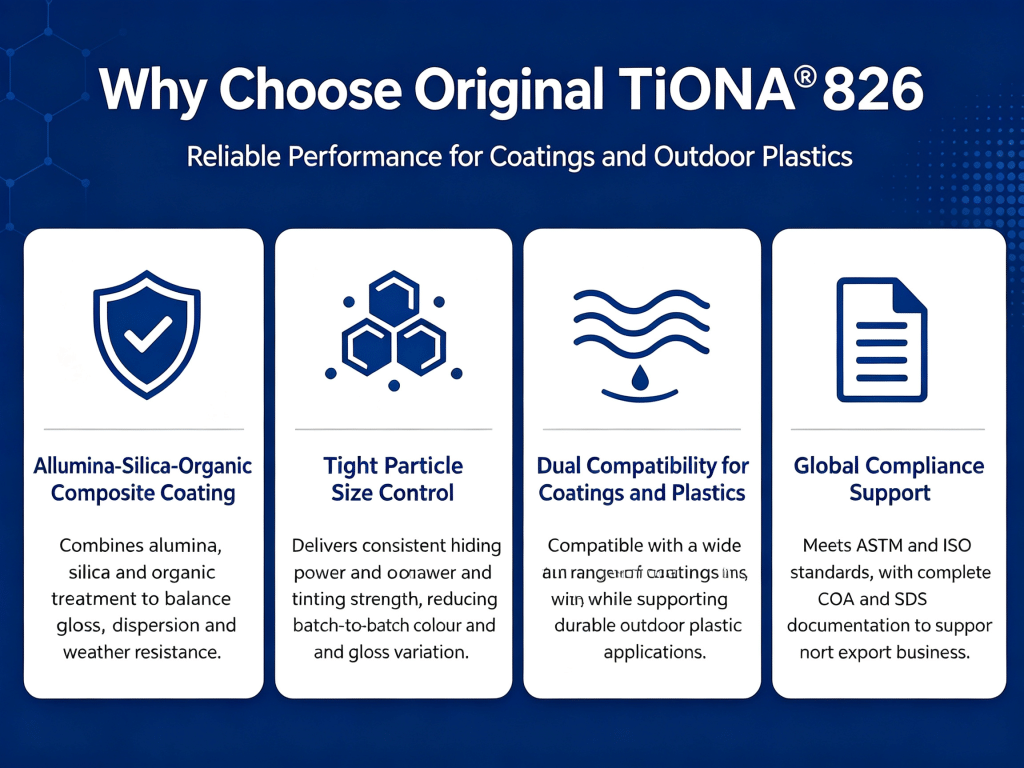
TiONA 826 infographic explaining alumina-silica-organic coating, particle size control, dual compatibility for coatings and plastics, and global compliance support
TiONA® 826 delivers reliable performance for coatings and durable outdoor plastics

Core Advantages of TiONA® 826

  • Alumina‑silica‑organic composite coating:
    balances gloss and dispersion, while safeguarding film weatherability and thermal stability during plastic processing
  • Precision particle‑size control via chloride process:
    delivers consistent tinting and hiding power, reducing colour and gloss drift and production rework
  • Dual‑use for coatings and outdoor plastics:
    covers architectural, industrial, automotive, marine and powder coatings alongside weatherable polymers, simplifying inventory
  • Optimised for eco‑friendly high‑solids systems:
    stable oil absorption for low‑VOC coating development
  • Complete global compliance package:
    meets ASTM and ISO standards with full COA / SDS documentation for export qualification

Many manufacturers have recognised that short‑term savings from switching to lookalike pigments are often erased by losses from colour inconsistency, gloss variation, plastic yellowing and failed export audits. For premium producers and export‑oriented factories, consistent supply, full compliance and multi‑process compatibility deliver superior long‑term cost efficiency.

Pigment selection should never rely only on static lab drawdowns. Where operating requirements are simple and cost control is prioritised, domestic TiO₂ can be a practical option. If your products target automotive finishes, marine protection, powder coatings, low‑VOC high‑solids systems, weatherable outdoor plastics or overseas markets, the full chloride‑process and composite‑coating system behind TiONA® 826 cannot be easily duplicated.

Disclaimer: Technical data is sourced from TRONOX® original TiONA® 826 TDS and field application experience, for technical reference only.

Business Contact:

South China:

Mr. Hu
(David)

+86 181 2822 2887

East China:

Ms. Zhou
(Amy)

+86 188 1771 1692

Indonesia & Taiwan:

Wilson

+886 955 678 462

Vietnam:

Hung

+84 91 823 2228

Similar Posts